| Captain's Drive In |

Captains' Drive-in
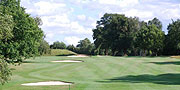
Unfortunately heavy rain meant the abandonment of the morning competition but the clouds rolled back for last year's captain, Robert Lemon to putt out and for Tim Corbett to drive-in. Though his drive was straight, he lost the competitive first hole to a nett birdie by the Lady Captain, Sally Graham. However, a pleasing sum was raised for the Captains' charities and convivial pre-lunch drinks were followed by an excellent and well supported carvery. Tim just hopes that his predecessor hasn't purloined all the good weather!
|
|
|
| An Upbeat AGM |
An Upbeat AGM
Review of the Year
At the AGM on Wed November 9th Wendy Living, Chairman, reviewed the positive progress made since last October when members voted to raise a levy of £200 on all playing members.
- Though we lost some 7 members who did not pay, the good news is that since October 2012 we have gained almost 30 new members. Membership deals remain in place but the best advertisement is word-of-mouth and introductions by existing members. Andrew’s Junior Golf section continues to thrive and has attracted some parents to join the club.
- The membership committee has been renamed the membership and marketing committee. Its brief is not only to attract new members but also to raise the profile of the Club with a number of initiatives. The website will be kept more up to date and further improvements will soon follow but more information about this in due course.
- There are now more social functions, both in number and variety, taking place both for members and for non-members. The feedback from people who have held functions here has been very positive and congratulations to Kerry and Billy for their efforts.
- On the cost front we have made savings in a variety of areas such as insurance premiums, waste collection and cleaning costs. We obtain discounts wherever we can for bulk buying and we review our costs constantly to ensure we are receiving the best value for money. We continue to review the Sky subscription and the Board is still of the view that the Club needs to offer this service.
- There have been improvements to the clubhouse including the painting of the exterior, the refurbishment of parts of the men’s and the ladies’ locker rooms, a new carpet in the lobby outside the pro shop and a new coffee machine.
- Finally, the course has been maintained in superb condition this year. In this coming year members will see further improvements to the course: the 5th tee is to be completely re-laid, the practice nets will have a new surface and new mats, and a new chipping area is to be created between the nets and the 10th teeing ground.
- In the back car park the old trolley shed and the old concrete shed will go to be replaced by a large machinery shed, making it easier for the greens staff to access the machinery and it will also be more secure.
- Thanks to Rob, Ramsay and Rod for giving us the best presented putting green in Hertfordshire. Unfortunately the gardeners’ bones are beginning to creak a bit so if there are any budding gardeners out there who would like to lend a hand tending the garden area please let us know.
- Administratively, with the help of other members supporting the voluntary work of Sally and David, the office will be open at set times each day. Also, having listened to members’ complaints, we will return to having a diary/handbook for 2014.
Elections and farewells
Gerry Goes and Robert Lemon, who were standing down from their respective positions as President and Captain, were warmly thanked and applauded for all their efforts on behalf of the Club. There is only space here for a brief record of the tributes made but members were reminded that Gerry had served the Club for almost 25 years as Director, Captain and President and throughout that time he had been unstinting in promoting the interests of the Club and its members while Robert had been an outstanding Captain, maintaining morale in a difficult financial year. The Club is extremely grateful to them both.
Don Foster was then elected President and Tim Corbett as Captain, with David Holt agreeing to serve as Vice-Captain. Earlier in the week Sally Graham was appointed Lady Captain for another year and Denise Slade as her Vice-Captain. The two retiring board members, Alan Bradley and John Jennings, were warmly thanked for outstanding service in so many areas. Wendy Living also thanked all those who worked for the Club either behind the bar with Billy, in catering with Kerry or on the greens with Jason, Sally and David for their tireless voluntary work in the Office, Andrew Hurley as our Director of Golf and finally all the members of the Board.
|
|
|
| Litter everywhere |

Litter, litter everywhere
After a litter pick in the front car park a couple of weeks ago on the day of the Ladies’ Open when there were visitors at the course, within five minutes there were two handfuls of plastic bottles, sweet wrappers, paper cups and sundry refuse and there was still rubbish left on the ground.
It is not the job of the greenkeepers to keep the car park clean – they have more than enough to do on the course. Please can all members make sure they do not drop rubbish inadvertently. If you do see rubbish it would be greatly appreciated if you could pick up even one discarded plastic bottle and put it in the bin. We take pride in the course and the clubhouse. Please extend that to the car parks as well.
|
|
|
| Captain Robert Lemon and his magic carpet |
Captain Robert Lemon and his 'Magic' Carpet
Dear Member
I had a wonderful time as Captain of Arkley GC and just wanted to thank you all for your support and generosity throughout the year. We had some fun with the Captain's Carvery Sunday lunches, the Race Night, the Quizzes, my Captain's Day and the August Bank Holiday Fund-raising Day.
You will see a new carpet in the stud bar as a direct result of August 26, when over £1000 was raised, whilst my Captain's charity paid for bag tags in April, contributed towards new crockery and the new shed project. I am also looking at additional garden furniture for next summer.
I now leave you in the capable hands of Captain Corbett and once again thanks, I had a ball.
Robert Lemon
|
|
|
| Seniors Trophy |
Seniors’ Trophy
The Seniors’ Trophy competition took place on Thursday 10th Oct. Some 36 players entered the competition and despite the wind and cold weather some very good scores were registered. With a special thanks to Mervyn Reed who kindly came along and did all the score cards. 38 players and guests sat down to lunch followed by the prize giving with the Captain’s apologies for not attending. As well as the winners there were three special prizes, two for Duncan Munro and Mel Moore for the only two birdies of the day, with JJ’s man of the year going to Eamon O’Gorman in recognition of all service he had given to both the Rabbits and Stags over the years. 1st Robin Morgan & Nigel Whiteley - 43 points 2nd David Ross & Martin Hamill - 41 points 3rd Kamlesh Upadhyaya (KAM) & Eddie Dennison -40 points The first two winning pairs will automatically be entered into next year’s Crameri Cup Competition. John Jennings, who is standing down from running the seniors’ matches, gave a big thank you for all the support he had been given over the years. He wished the incoming managers David Ross (Stags) and John Casalaspro (Rabbits) every success.
|
|
|
| Trolley Shed Clear-out |
Trolley Shed Clear-out!
The trolley shed is becoming like a scrap merchant’s yard. There are bits of trollies, dead batteries and all sorts of other items littering the corners and floor of the shed. We are going to have a major clear out over the winter. If you have anything in the shed which should not be there – either because you have not paid for it to be there or because it is defunct and you have just abandoned it, could you please remove the offending items by November 30. Anything left in the shed after that date which is not recorded as having been paid for will be disposed of. You have been warned!
|
|
|
| Storm Ravages Arkley |
 
Storm Ravages Arkley
The St Jude storm ravaged our course in the early hours of Monday 28th October and sadly we have lost around 5 mature trees. The most significant loss has been the large oak on the corner of the ditch on the 4th fairway, altering the character of the hole: shots drifting right will now be much less penalised. There has also been extensive damage to the third green where large fallen boughs have damaged the turf. Leaves and debris are everywhere with the 8th fairway particularly obstructed.
Jason and David have worked tirelessly to get the course open – and of course it was the week when Kevin was away on leave - well done, a fantastic effort. Meanwhile the grass is still growing at the rate of knots and the bunkers are filled with autumn leaves. Members will need to be patient as it will take time for the course to be brought back to its usual immaculate condition.
|
|
|
| Arkley Choir? |
An Arkley Choir?
Are there any singers out there? We thought it would be fun to try to put together a small choir for some Christmas singing. Whether to give a small concert or merely to lead the Club in some Christmas cheer depends very much on the response. You don’t have to be an expert but merely enjoy singing. Similarly if there is anyone else out there with other musical talents such as playing a musical instrument please let us know. And if you know of anyone that might be shy in coming forward do tell us their names!!
|
|
|
| Drive In |
Drive in
The Captain and Lady Captain will be having a joint drive-in on Sunday 13 October.
There is a Captain's competition on that day but do join Tim and Sally for their drive-in. Complimentary cheese and wine/ beer from 12.30 pm will be followed by the drive-in at 1.30pm.
And why not sign up for the carvery lunch which immediately follows – join a table or bring friends and family along for one of Kerry’s great Sunday lunches.
|
|
|
| Social Events |
Social Events
Although late summer gently lingers on, the Social Committee is turning its attention to Christmas and, in particular, New Year's Eve. Our NYE parties have been much fun over the years, but we do recognise that some members have other considerations and obligations at this time of year.
So please help by giving us your feedback / expectations and most importantly, whether you are considering coming along to the NYE party on Dec 31, 2013. Please contact Tim, Ann or Robert.
timcorbett@hotmail.co.uk
ann@annbunyard.freeserve.co.uk
robertlemon @live.co.uk
|
|
|
| Congrats to Mike Smith |

Congratulations to Mike Smith -
who got a hole-in-one on the 11th when playing in the Saturday morning swindle on Sept 21st.
|
|
|
| Crash Landing |

Crash Landing at Arkley
The annual Wooden Spoon competition between the men and ladies had a late entry on the 17th fairway! One of 3 swans flying over ran out of steam, landed on the fairway and settled into a bunker. Help was at hand from our Lady Captain who contacted the Swan Sanctuary to come to the rescue. As you can see she wasn't brave enough to pose for the photo! The result of the match - the Ladies reclaimed the Wooden Spoon 3 to 1.
The Ladies also had a most enjoyable away day at the Hertfordshire, and a successful Autumn meeting despite one of the few inclement days of the summer.
|
|
|
| Quizzes |
A forthcoming big social event will be Kevin Jarrett’s annual quiz on Saturday 16 November, though John Casalaspro’s more intimate Thursday quiz evenings will also be starting soon.
Watch out for details.
|
|
|
| Cups |

Cups, cups and more cups
The photo shows some of the winners of the annual competitions at the Presentation Evening. Of the more prestigious prizes, Terry Hodgson won the Order of Merit (the player amassing the most points throughout the year), Steve Giles won the Capes Cup (the Scratch championship) and Kevin Jarrett triumphed in the Singles Knockout, after defeating Gerry Goes in a closely fought contests over 36 holes. A complete list of winners will be displayed as usual in the Club House.
|
|
|
| Round and About |
Round and About
- Congratulations to the Ladies who with Kerry organised a Ladies Coffee morning and raised £400 for Macmillan Nurses on September 27th.
- Congratulations to Eddie Dennison who won the Wednesday Boys Cup on September 25 with a score of 40 stableford points
- Despite disappointingly small fields, the two inivitation days (Men’s and Mixed), were played in good weather and much enjoyed. Make a point of playing in one next year.
- The Past Captains versus the Club ended in a genuine and honourable draw.
|
|
|
| Slow Play |

Slow play
In recent months there have been a number of incidents of slow play both in competitions and in casual play. The Rules of Golf (Etiquette section) are clear on the subject -
It is a group’s responsibility to keep up with the group in front. If it loses a clear hole and it is delaying the group behind, it should invite the group behind to play through, irrespective of the number of players in that group. Where a group has not lost a clear hole, but it is apparent that the group behind can play faster, it should invite the faster moving group to play through.
All players should respect the rules and other players and where necessary not only let others play through but positively invite them to do so.
|
|
|
| Mike |
Some of you early morning players may have seen a man with a bird of prey walking around the course and wondered who he is and what he is doing. When I saw him last week I asked him to tell me more and explain why he no longer had his dog with him as he had a year or two back. Here is his answer.

I am Mike Warren and I fly a female Harris hawk and work a pair of albino ferrets on the course between the months of late September and early February.
I have had permission to fly on the course since 2003. When I was first coming on the course it was with my old girl Porsche and my dog Chester, a German short haired pointer, and the main quary then was squirrel and rabbit. The rise in the number of rabbits on the course has meant that we are taking more rabbits than squirrel. With the use of the ferrets the rabbit took a hit last season and we hope to do the same again this season.
I am usually on the course early and aim to be off before 9am and then we go to the practice area for an hour or so. If you see me I am always up for a chat and it is the same faces that I see most mornings.
The bird that is being used at the moment on the course is named Bella and the ferrets are known as The Twins (as they are both white with pink eyes).
 
|
|
|
| A Lick of Paint |
A Lick of Paint
With a fresh coat of paint and a particularly glorious central display of flowers on the putting green the club has been looking particularly resplendent in the recent glorious summer weather. Congratulation and thanks to all those involved.

|
|
|
| A1 Driving Range |

We have entered in to an agreement with the A1 Range that we hope will be beneficial to both organisations ; for us, hopefully bringing in some new members to the club.
Arkley members who use the A1 range and use one of their loyalty cards will receive a credit of £75 if they load on £50. Also Arkley will get free advertising space in some of the bays at the A1 range.
You can find more information about the A1 range on their website - http://www.a1golfrange.co.uk/
|
|
|
| Function Room Hire |
Function Room Hire
Many members will know that we hire out various parts of the club for functions, hiring out the venue brings in some much needed extra revenue and increases takings over the bar but do members realise what very good value hiring Arkley is?
We believe we offer some of the best, if not the best, value for miles around and as members get a significant discount the value for them is exceptional. The dining room is only £100 (£40 for a member) and can accommodate up to 40 guests, the main lounge costs £200 (£75 for a member) and can take up to 100 guests. So if you, or someone you know are looking for a function venue make sure that Arkley is considered - Spread the Word!
Full details can be obtained from the office (we'll be as flexible as we can to help). |
|
|
|